Summary:
Faux wood blinds are made from PVC, composite, or polymer materials that mimic natural wood while offering superior moisture resistance and easier maintenance. Real wood blinds provide unmatched natural beauty and insulation, making them ideal for dry living spaces. The best choice depends on your room, climate, and budget.
Key Takeaways
- Faux wood blinds are window blinds made from PVC, composite wood, or polymer materials engineered to replicate the appearance of real wood, offering significant practical advantages over natural timber in specific applications.
- What is faux wood blinds in precise terms, a blind manufactured from synthetic or composite materials with a wood-grain finish, designed to deliver the aesthetic of timber without its moisture sensitivity and maintenance requirements.
- The core faux wood blinds vs real wood blinds distinction is moisture resistance, faux wood blinds are impervious to humidity, warping, and moisture damage; real wood blinds are vulnerable to all three.
- Wood vs faux wood blinds on aesthetics, real wood offers genuine natural grain, texture depth, and warmth that the best faux alternatives closely but not perfectly replicate; for design-critical spaces where authenticity matters, real wood retains an edge.
- Faux wood blinds vs wood blinds on durability, faux wood significantly outperforms real wood in humid environments including bathrooms, kitchens, and monsoon-season balconies.
- Custom wood blinds, whether real or faux, are available from quality blinds manufacturers in India in a wide range of slat widths, stain colours, and operating systems to suit virtually any window size and interior style.
- Wooden blinds vs faux wood blinds on price, real wood commands a significant premium; faux wood delivers a comparable aesthetic at 30–50% lower cost in most market segments.
- The right choice between faux wood blinds vs real wood blinds is determined primarily by room location, real wood for dry, temperature-stable living rooms and bedrooms; faux wood for kitchens, bathrooms, and any space with significant humidity exposure.
Introduction
Few window treatments achieve the combination of visual warmth, textural richness, and light-control versatility that wooden blinds deliver. Whether in a traditional heritage home, a contemporary urban apartment, or a warmly designed villa, timber blinds bring an organic quality to interior spaces that most synthetic alternatives struggle to replicate convincingly.
Yet for Indian homeowners, real wood blinds come with a set of practical challenges that are particularly acute in the subcontinent’s climate, high monsoon humidity, dramatic seasonal temperature swings, and the moisture-heavy environments of Indian kitchens and bathrooms that cause real timber to warp, swell, crack, and discolour over time.
Faux wood blinds have emerged as a direct response to these challenges, engineered to deliver the visual character of timber while eliminating its moisture sensitivity and high maintenance requirements. But the faux wood blinds vs real wood blinds choice is not straightforward, real wood retains genuine advantages in specific applications, and the decision deserves a room-by-room, property-specific evaluation rather than a blanket recommendation.
What Are Faux Wood Blinds?
What are faux wood blinds in technical terms? A faux wood blind is a window blind manufactured from one of three primary synthetic or composite materials, each engineered to replicate the visual appearance of natural timber:
PVC Faux Wood Blinds
The most common and most affordable faux wood blind construction, individual slats made from solid PVC with a wood-grain embossed or printed surface finish:
- Completely waterproof, 100% impervious to moisture, making them the ideal choice for bathrooms, kitchens, and laundry areas.
- Lightweight, easier to operate than real wood blinds, particularly on larger windows.
- Most affordable entry point in the faux wood blinds category.
- Available in a wide range of wood-grain finishes, oak, walnut, cherry, and white washed effects.
- Limitation: Large PVC slats can show a degree of flex or bend under their own weight, less of an issue on smaller windows.
Composite Wood Faux Blinds
A mid-range faux wood blind construction, combining real wood fibres with polymer binders to create a denser, more dimensionally stable slat than pure PVC:
- More rigid than PVC faux wood, composite slats hang straighter and feel more substantial.
- Better moisture resistance than real wood, though not fully waterproof like PVC.
- Closer visual match to real wood, the timber fibre content gives composite faux blinds a more authentic grain appearance.
- The preferred faux wood blind choice for living rooms and bedrooms where aesthetics matter but real wood’s moisture sensitivity is a concern.
Polymer Faux Wood Blinds
Premium faux wood blinds manufactured from engineered polymer compounds with high-detail wood-grain surface texturing:
- The closest visual match to real wood available in the faux wood blinds category.
- Excellent dimensional stability, minimal expansion or contraction with temperature and humidity changes.
- Higher price point than PVC but typically below real wood custom wood blinds pricing.
- The best choice when appearance is the primary consideration but real wood’s practical limitations make it unsuitable.
Real Wood Blinds: The Case for Natural Timber
Before examining the faux wood blinds vs wood blinds comparison in detail, understanding what real wood blinds genuinely offer, and why they remain a relevant choice despite the availability of quality faux alternatives, is important.
What Real Wood Blinds Offer
- Authentic natural grain: No two real wood slats have exactly the same grain pattern, the organic variation of natural timber creates a visual richness and authenticity that even the best faux wood blinds approach but rarely fully equal.
- Weight and tactile quality: Real wood blinds have a substantial, premium feel, the weight and texture of natural timber communicate quality in a way that synthetic materials do not fully replicate.
- Thermal insulation: Natural wood is a genuine thermal insulator, real wood blinds provide measurably better insulation than PVC or polymer alternatives, reducing heat loss through windows in winter.
- Customisation depth: Custom wood blinds in real timber offer the widest range of stain, paint, and finish options, including bespoke colour matching that is not achievable with synthetic alternatives.
- Design statement: In a carefully designed interior where material authenticity matters, heritage homes, luxury residential projects, high-end hospitality, real wood blinds make a design statement that faux wood blinds cannot fully replicate.
Real Wood Blind Limitations
- Moisture sensitivity: Real wood expands, contracts, warps, and cracks under humidity, a serious limitation in India’s monsoon climate and in moisture-heavy rooms.
- Higher price: Real wood custom wood blinds command a significant premium over equivalent faux wood blinds, reflecting the material cost and manufacturing complexity of natural timber.
- Weight: Heavier than faux alternatives, particularly on large windows where the weight of real wood slats makes operation more effortful.
- Maintenance: Real wood requires periodic cleaning with specific products and must be kept dry, a more demanding maintenance routine than faux wood blinds.
Faux Wood Blinds vs Real Wood Blinds: A Complete Comparison
| Parameter | Faux Wood Blinds | Real Wood Blinds |
|---|---|---|
| Material | PVC, composite wood-polymer, or engineered polymer with wood-grain finish | Natural timber — typically basswood, paulownia, or teak |
| Visual Authenticity | Convincing wood-grain finish — closely replicates real wood at normal viewing distances | Genuine natural grain variation and organic texture — visually superior on close examination |
| Moisture Resistance | Excellent — PVC variants are 100% waterproof; composite and polymer variants offer high moisture resistance | Poor — real wood expands, contracts, warps, and cracks under humidity and direct moisture exposure |
| Suitability for Bathrooms | Ideal — PVC faux wood blinds are the only timber-look option suitable for bathroom humidity | Not suitable — moisture damage is near-certain over time in bathroom environments |
| Suitability for Kitchens | Excellent — PVC and composite variants resist steam, condensation, and grease; easy to wipe clean | Not recommended — cooking steam and condensation cause warping and surface deterioration |
| Suitability for Living Rooms | Very good — composite and polymer variants deliver near-authentic appearance | Ideal — dry, stable environment protects timber; visual authenticity at its most valuable |
| Suitability for Bedrooms | Excellent — practical choice delivering comparable aesthetics at lower cost | Good — performs well in dry bedroom environments but commands an unnecessary price premium |
| Durability in Indian Climate | Superior — immune to monsoon humidity, seasonal temperature extremes, and moisture cycling | Limited — Indian climate conditions accelerate warping, cracking, and surface deterioration |
| Maintenance Requirements | Minimal — wipe with damp cloth; PVC variants can be wiped with wet cloth without damage | More demanding — requires dry dusting, specific wood-care products, and strict moisture avoidance |
| Weight | Lighter — particularly PVC constructions; easier operation on large windows | Heavier — larger slats and wider windows require more operational effort; adds stress to mechanisms |
| Thermal Insulation | Moderate — better than fabric but less effective than natural wood | Good — natural wood is a genuine thermal insulator; measurably reduces winter heat loss |
| Price Point | 30–50% lower than equivalent real wood blinds | Significant premium — higher material and manufacturing cost |
| Customisation Options | Wide range of wood-grain finishes, colours, slat widths, and operating systems | Widest range — bespoke stain matching, paint finishes, and grain selection not achievable with synthetics |
| Operating Systems | Cord, cordless, and motorised — lighter weight suits cordless and motorised particularly well | Cord, cordless, and motorised — heavier weight makes cordless operation more effortful on large windows |
| Mold and Mildew Risk | None — PVC and polymer surfaces do not support mold or mildew growth | Present — prolonged moisture exposure creates mold risk on real wood surfaces |
| UV Resistance | Good — UV-stabilised formulations prevent yellowing and surface degradation | Moderate — real wood fades and surface finishes degrade under prolonged UV exposure |
| Best For | Bathrooms, kitchens, high-humidity spaces, monsoon-affected locations, budget-conscious homeowners | Dry living rooms, heritage homes, luxury residential projects, design-critical showcase spaces |
| Overall Value in Indian Conditions | Superior — practical advantages significantly outweigh the visual authenticity gap for most applications | Justified only where design authenticity is the primary criterion and environment is stable and dry |
Wooden Blinds vs Faux Wood Blinds: Room-by-Room Guide
The wooden blinds vs faux wood blinds decision is best made room by room:
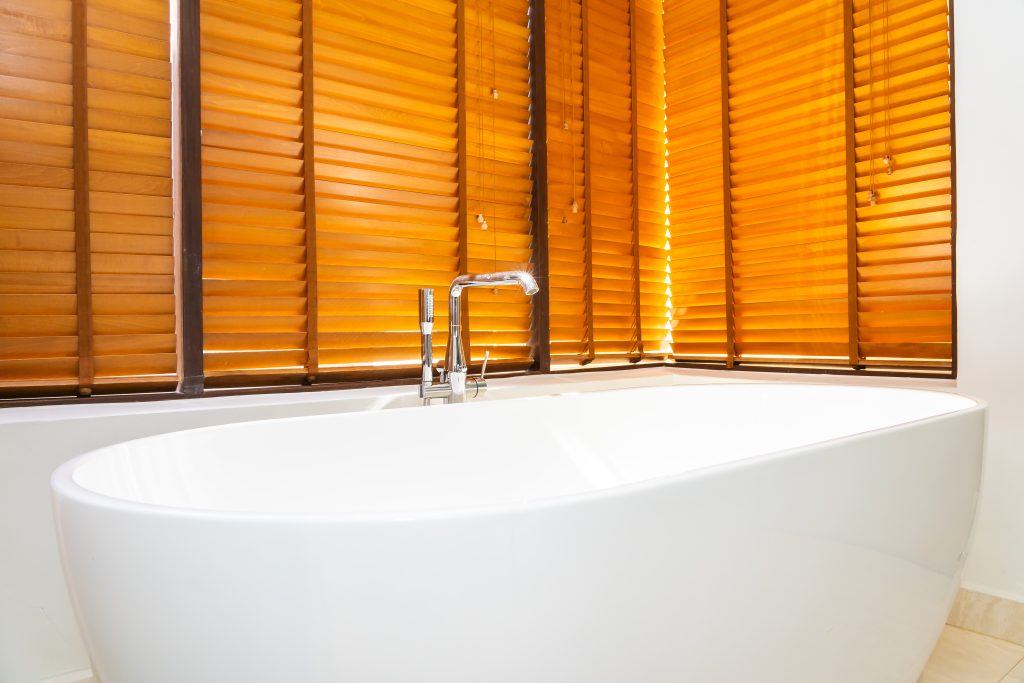
Bathroom
Recommendation: Faux wood blinds (PVC): Bathroom humidity makes real wood blinds entirely unsuitable, warping and mold risk are near-certain over time. PVC faux wood blinds are 100% waterproof and the only practical timber-look option for bathroom windows.
Kitchen
Recommendation: Faux wood blinds (PVC or composite): Steam, cooking condensation, and grease make kitchens highly challenging for real wood. Faux wood blinds in PVC or composite withstand these conditions, and are easy to wipe clean after cooking sessions.
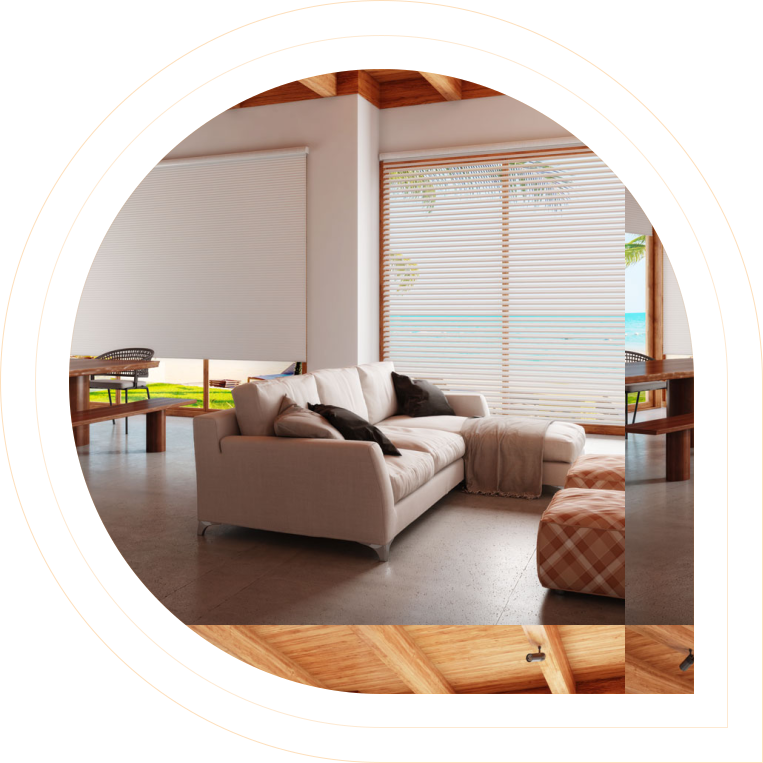
Living Room
Recommendation: Real wood or composite faux wood blinds: The living room is the showcase space where visual authenticity matters most, real wood custom wood blinds make their strongest case here, in a dry, air-conditioned environment that protects timber from moisture damage. For budget-conscious homeowners, composite faux wood blinds deliver a near-equivalent aesthetic at significantly lower cost.
Bedroom
Recommendation: Composite or polymer faux wood blinds. Bedrooms are generally dry environments where real wood would perform well, but the cost saving of composite faux wood blinds at comparable visual quality makes them the more practical choice for most homeowners.
Home Office
Recommendation: Faux wood blinds (composite) Home offices benefit from glare control and a professional, warm aesthetic, composite faux wood blinds deliver both at a price point that suits a functional workspace rather than a showcase room.
Balcony or Outdoor-Adjacent Windows
Recommendation: Faux wood blinds (PVC) Any window adjacent to a balcony, terrace, or outdoor space that experiences monsoon humidity and temperature variation should always use PVC faux wood blinds, real wood deterioration in these positions is rapid and costly.
Also Read: Why Wooden Blinds Are a Timeless Choice for Every Home
Adorn Blinds & Shades: Real Wood and Faux Wood Blind Specialists
At Adorn Blinds & Shades, we offer a comprehensive range of both real wood and faux wood blinds manufactured and installed to the highest standards. Our custom wood blinds option allows homeowners to specify exact dimensions, slat widths, finishes, and operating systems, whether in premium natural timber for living room showcase installations or in high-quality PVC and composite faux wood blinds for the practical demands of Indian kitchens, bathrooms, and high-humidity environments.
Our design consultants provide room-by-room recommendations based on each space’s specific humidity exposure, aesthetic requirements, and budget, ensuring every blind we supply and install delivers both the appearance and the performance it promises. Contact Adorn Blinds & Shades today to explore the full range of real wood and faux wood blind options for your home.
Conclusion
The faux wood blinds vs real wood blinds debate does not have a single correct answer, it has a correct answer for each room, each climate condition, and each homeowner’s priorities. Faux wood blinds win on moisture resistance, durability in Indian conditions, maintenance simplicity, weight, and price, making them the practical choice for the majority of Indian residential applications. Real wood custom wood blinds win on visual authenticity, thermal insulation, and tactile quality, making them the right choice for dry, temperature-controlled showcase spaces where budget is not the primary constraint.
Get the wooden blinds vs faux wood blinds choice right for each room, invest in quality installation from a trusted specialist like Adorn Blinds & Shades, and your window treatments will deliver the warmth, beauty, and performance you invested in for years to come.